

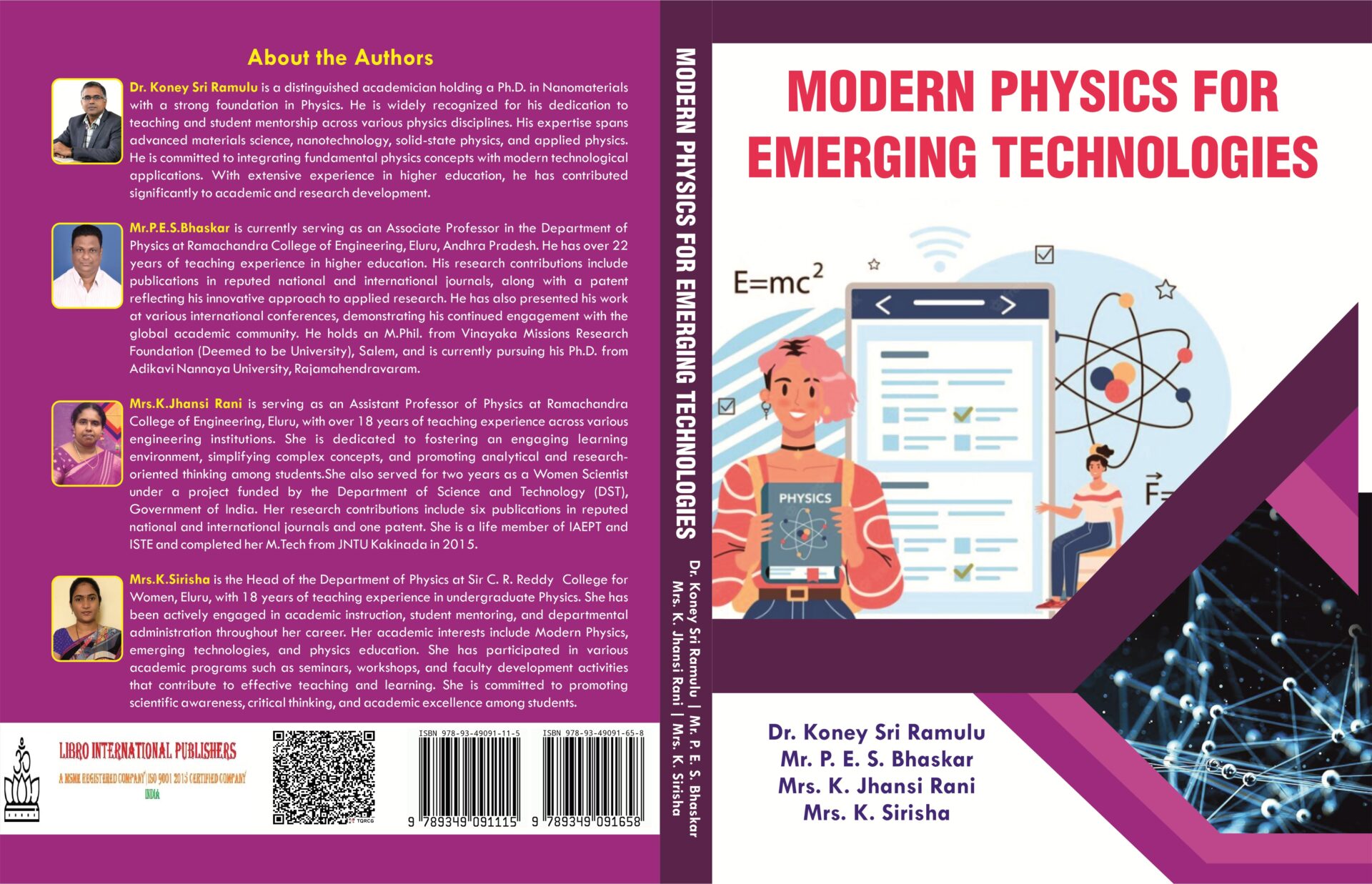

Modern physics has profoundly transformed our understanding of the natural world and has become the foundation for many of today’s most significant technological advancements. Concepts that once appeared purely theoretical—such as quantum mechanics, atomic structure, and particle interactions—now drive innovations in electronics, communication systems, energy technologies, nanotechnology, and biomedical applications. The rapid development of emerging technologies demands a strong conceptual understanding of modern physics principles, making this field increasingly important for students, researchers, and professionals in science and engineering.
The book “Modern Physics for Emerging Technologies” has been prepared as a multi-author academic resource with the aim of presenting the core ideas of modern physics in a clear, structured, and application-oriented manner. Each contributing author brings valuable expertise and teaching experience from the field of physics and related disciplines. Their collective efforts have helped shape a comprehensive text that bridges fundamental physical principles with their relevance to modern technological developments.
The book is organized into six carefully structured units, designed to guide readers from the fundamental principles of modern physics to their practical applications in emerging technologies.
Unit 1: Foundations of Modern Physics introduces the conceptual origins of modern physics. It discusses key phenomena such as blackbody radiation, the photoelectric effect, the Compton effect, wave–particle duality, and the Heisenberg uncertainty principle. These topics highlight the transition from classical physics to quantum ideas that revolutionized scientific thinking.
Unit 2: Quantum Mechanics and Quantum Technologies focuses on the theoretical framework that underpins modern physical science. It presents the fundamentals of quantum mechanics, the Schrödinger equation and its applications, and the concept of quantum states. The unit also introduces the basic ideas of quantum computing, demonstrating how quantum principles are being utilized in next-generation computational technologies.
Unit 3: Atomic, Molecular and Laser Physics explores the structure and behavior of matter at the atomic and molecular levels. Topics such as atomic models, the hydrogen atom, spin and magnetic properties, and molecular physics are discussed. The unit also introduces laser physics, which plays a crucial role in communication, medical technologies, and industrial applications.
Unit 4: Solid State Physics and Nanotechnology examines the physical properties of solid materials that form the basis of modern electronic devices. It covers crystal structures, energy band theory, semiconductor physics, and the rapidly growing field of nanotechnology. These concepts are essential for understanding microelectronics, nanomaterials, and advanced device engineering.
Unit 5: Nuclear and Particle Physics presents the principles governing the atomic nucleus and fundamental particles. Topics such as nuclear structure, radioactivity, nuclear reactions, nuclear fission, and elementary particles are discussed to provide insight into nuclear energy, particle accelerators, and fundamental interactions in nature.
Unit 6: Modern Physics in Emerging Technologies connects theoretical physics concepts with cutting-edge technological applications. This unit explores photonics, spintronics, superconductivity, modern energy technologies, and biomedical as well as nano-scale applications, illustrating how modern physics continues to shape future technological innovations.
This book is primarily intended for undergraduate and postgraduate students of physics, engineering, and applied sciences, as well as educators and researchers who wish to gain a deeper understanding of the relationship between modern physics and emerging technological fields. The authors have made every effort to present the material in a logical and accessible manner while maintaining academic rigor.
As a multi-author volume, this work reflects the collaborative effort of dedicated educators and researchers who share a common goal: to provide a valuable learning resource that inspires curiosity and innovation in the study of modern physics. The editors express their sincere appreciation to all contributing authors for their scholarly contributions, dedication, and commitment in making this book possible.
We also extend our gratitude to colleagues, students, and academic institutions whose encouragement and support have been instrumental in the completion of this work. It is our hope that this book will serve as a meaningful resource for learners and will contribute to the advancement of knowledge in modern physics and its technological applications.
Despite our best efforts, any remaining errors or omissions are unintentional, and we welcome constructive suggestions from readers for improving future editions of this book.





Reviews
There are no reviews yet.