

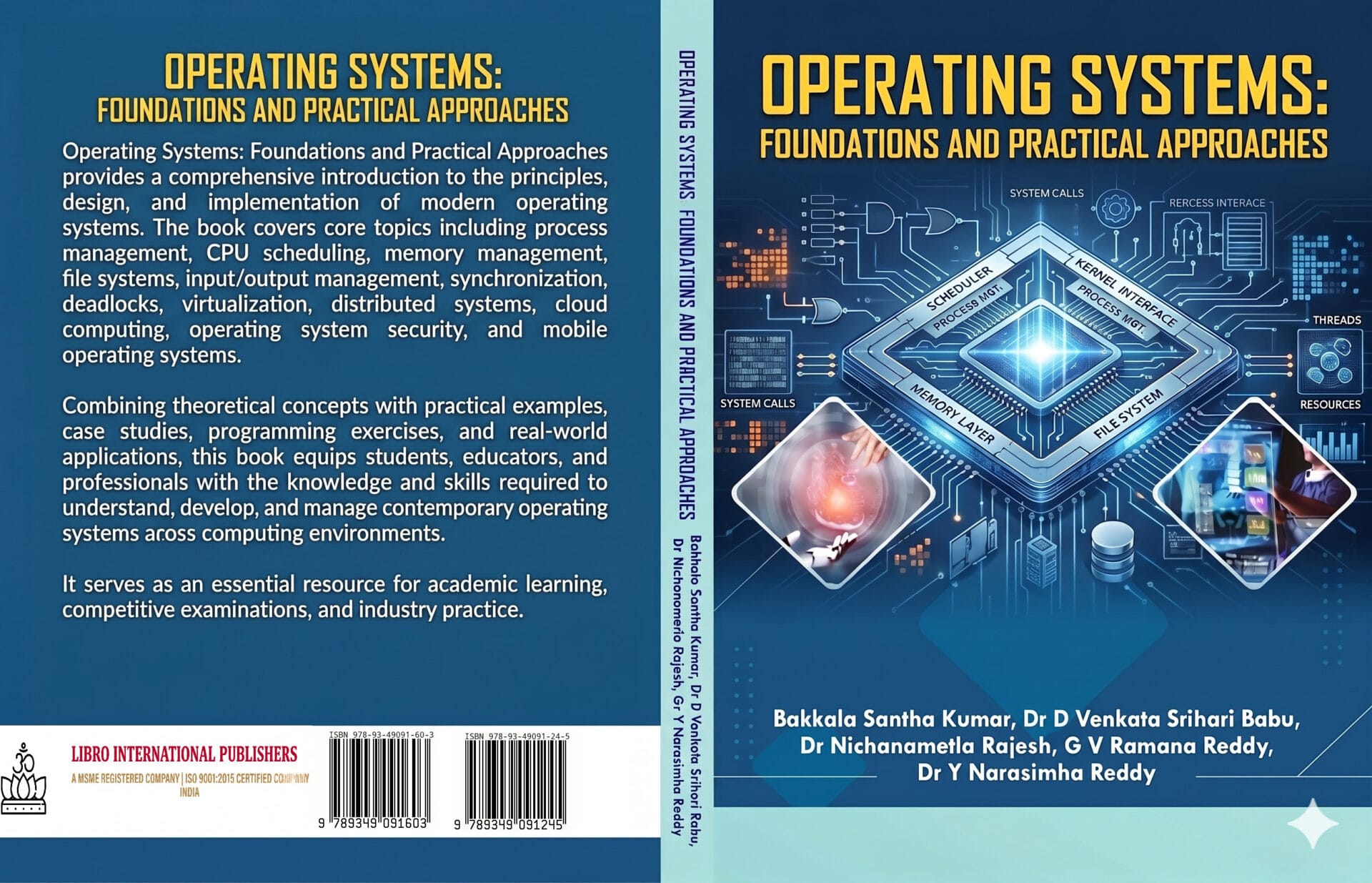
The rapid evolution of computing technologies has transformed operating systems from simple resource managers into sophisticated platforms that support cloud computing, virtualization, distributed systems, artificial intelligence, mobile computing, and high-performance applications. As modern computing environments continue to evolve, a comprehensive understanding of operating system concepts has become essential for students, educators, researchers, software developers, and system administrators. Recognizing this need, we are delighted to present Operating Systems: Foundations and Practical Approaches, a textbook that combines theoretical foundations with practical implementation strategies to provide a holistic understanding of contemporary operating systems.
This book has been carefully designed to bridge the gap between academic learning and industrial practice. While traditional operating system textbooks emphasize theoretical concepts, this book integrates conceptual knowledge with practical examples, real-world case studies, programming perspectives, and emerging technologies. Our objective is to enable readers not only to understand how operating systems function but also to appreciate their critical role in today’s computing ecosystem.
The book begins with the fundamental concepts of operating systems, including their evolution, architecture, system calls, kernel structures, and operating system services. It progressively explores process management, multithreading, CPU scheduling algorithms, synchronization mechanisms, deadlock handling, memory management, virtual memory, storage organization, file systems, and input/output management. These topics establish a solid conceptual foundation necessary for advanced studies and professional practice.
Recognizing the growing significance of modern computing paradigms, subsequent chapters introduce readers to distributed operating systems, cloud computing support, virtualization, containerization technologies, multicore and parallel processing, mobile operating systems, real-time operating systems, and operating system security. Special emphasis has been placed on practical implementations using Linux, Windows, and Unix-based systems, enabling readers to connect theoretical concepts with real-world operating environments.
To strengthen analytical and problem-solving skills, every chapter incorporates practical examples, algorithmic explanations, diagrams, case studies, review questions, programming-oriented discussions, and application scenarios. These pedagogical features encourage learners to develop both conceptual understanding and practical competence, making the book suitable for classroom instruction, self-learning, laboratory courses, and professional development.
This textbook is intended primarily for undergraduate and postgraduate students in Computer Science, Information Technology, Software Engineering, Artificial Intelligence, and related disciplines. It will also serve as a valuable reference for faculty members, researchers, software professionals, system engineers, and candidates preparing for competitive examinations such as GATE, UGC-NET, and technical recruitment examinations.
The successful completion of this book has been possible through the collective efforts and academic expertise of all contributing authors. Each author has brought valuable teaching experience, research knowledge, and professional insights that have enriched the quality and depth of this work. Our collaborative approach has ensured that the content remains academically rigorous, practically relevant, and accessible to learners with diverse backgrounds.
We express our sincere gratitude to our respective institutions, colleagues, students, reviewers, and well-wishers whose encouragement and constructive suggestions have significantly contributed to the development of this textbook. We also acknowledge the numerous researchers, educators, and industry experts whose pioneering work in operating systems has inspired many of the concepts presented in this book.
Despite our sincere efforts to ensure accuracy and completeness, the field of operating systems continues to evolve rapidly. We therefore welcome constructive suggestions and feedback from readers for future editions. Such valuable inputs will help us further enhance the quality, clarity, and usefulness of this textbook.
We hope that Operating Systems: Foundations and Practical Approaches serves as a reliable academic companion, inspiring readers to build a strong foundation in operating systems while encouraging innovation, research, and practical excellence in modern computing.


MAECENAS IACULIS
Vestibulum curae torquent diam diam commodo parturient penatibus nunc dui adipiscing convallis bulum parturient suspendisse parturient a.Parturient in parturient scelerisque nibh lectus quam a natoque adipiscing a vestibulum hendrerit et pharetra fames nunc natoque dui.
ADIPISCING CONVALLIS BULUM
- Vestibulum penatibus nunc dui adipiscing convallis bulum parturient suspendisse.
- Abitur parturient praesent lectus quam a natoque adipiscing a vestibulum hendre.
- Diam parturient dictumst parturient scelerisque nibh lectus.
Scelerisque adipiscing bibendum sem vestibulum et in a a a purus lectus faucibus lobortis tincidunt purus lectus nisl class eros.Condimentum a et ullamcorper dictumst mus et tristique elementum nam inceptos hac parturient scelerisque vestibulum amet elit ut volutpat.


Reviews
There are no reviews yet.