


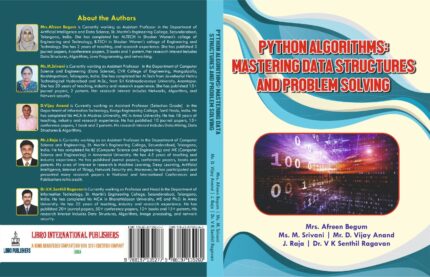
In the ever-evolving world of software development, Python has emerged as one of the most powerful and versatile programming languages. It is widely used across various domains, including web development, data science, systems programming, artificial intelligence, and scientific computing. Python’s simplicity, readability, and expressive syntax make it an ideal language for beginners, while its extensive libraries and advanced capabilities provide a vast landscape for experienced programmers to explore and master.
The book Problem Solving and Python Programming has been written with the aim of providing readers with a deeper understanding of Python programming while strengthening their problem-solving skills. The primary objective of this book is to bridge the gap between basic Python knowledge and advanced problem-solving techniques required in real-world software development.
In this book, I explore a wide range of important topics including functional programming concepts, concurrent and parallel programming, object-oriented programming techniques, design patterns, data manipulation strategies, and performance optimization. In addition, the book introduces readers to Python’s rich ecosystem of libraries and tools used for testing, web development, graphical user interface design, and numerical computing.
The chapters in this book are carefully structured to guide readers through a progressive learning path. Each chapter focuses on a specific aspect of Python programming while building upon previously introduced concepts. The intention is to provide a comprehensive learning experience that helps readers gradually develop confidence in applying Python to complex computational problems.
The references cited throughout this book have been extremely valuable in shaping its content. Several influential works, such as Fluent Python by Luciano Ramalho, Python Cookbook by David Beazley, and Effective Python by Brett Slatkin, have served as key inspirations in presenting advanced Python programming concepts. Additionally, official Python documentation, academic publications, and contemporary research materials have been consulted to ensure accuracy and relevance.
This book is intended to serve both as a learning companion for students and as a practical reference for professionals. Whether you are a student seeking to strengthen your programming foundation, a developer working on complex systems, or an educator guiding learners in modern programming practices, this book aims to support your journey toward writing efficient, elegant, and Pythonic code.
Finally, I extend my sincere appreciation to the readers who choose this book as part of their learning journey. Your curiosity, dedication, and enthusiasm for programming continue to inspire the growth of the global Python community. I hope this book contributes meaningfully to your understanding of Python and enhances your ability to solve real-world computational challenges.






Reviews
There are no reviews yet.